Sensitive Stomach Dog Food: Key Facts at a Glance
Definition: Sensitive stomach dog food is a complete diet formulated with highly digestible proteins, limited ingredients, or added prebiotics and probiotics intended to ease vomiting, diarrhea, gas, and bloating in dogs with digestive sensitivity. Many formulas pair a single, gentle protein with easily digested carbohydrates.
- Common triggers: beef, dairy, chicken and wheat are the most likely food allergens in dogs.[1]
- Transition rule: Change food gradually over several days; a sudden switch can cause loose stools.
- Single protein helps: Limited ingredient diets with one novel protein, like salmon or turkey, make elimination trials possible.
- Probiotics: Some products list live probiotics. In a 2024 meta-analysis of randomised trials in dogs with acute diarrhoea, nutraceuticals (prebiotics, probiotics and synbiotics) did not show a clinically significant effect on how long diarrhoea lasted.[2] Evidence: limited
- Prebiotic fiber: Ingredients like beet pulp and chicory are common in these formulas.
- Fat matters: Compare the guaranteed analysis on the bag, and ask your vet if fat seems to upset your dog.
- Wet vs dry: Wet food adds moisture, while dry kibble is often less expensive per meal.
- Breed connection: See the breed notes below for points to raise with your vet.
- Vet first: Persistent vomiting, blood in stool, or weight loss warrants a vet visit before any diet change.
- Feeding trials: Give any new sensitive formula a fair trial before judging results, and ask your vet how long to wait.
- Top reviewed: Purina Pro Plan Sensitive and Hill's Sensitive Stomach are the two best-known sensitive formulas on the list.
Why Do Dogs Get Sensitive Stomachs?
Quick answer: Sensitive stomachs can have several causes, including food triggers, stress, eating too fast, or underlying conditions. Identifying the trigger is a useful first step.
A sensitive stomach in dogs can be caused by food allergies, intolerances to specific proteins or grains, eating too fast, stress, or a digestive system that simply reacts badly to low-quality ingredients. Some breeds have specific digestive points to raise with your vet, as covered below.
The signs are usually clear: frequent vomiting, loose stools, excessive gas, or a dog that seems uncomfortable and lethargic after eating. Many dogs improve after a suitable food change, but some need a vet to find the cause.
What to Look for in Dog Food for Sensitive Stomachs
Quick answer: Look for a single gentle protein, limited ingredients, and added probiotics or prebiotics. Avoid any protein that is a known trigger for your dog.
Not all "sensitive stomach" labels mean the same thing. Here is what actually matters when you are reading the bag:
- Limited ingredients: Fewer ingredients means fewer potential triggers. Look for a single, named protein source at the top of the list.
- Named proteins: Check the label for a named protein source such as chicken, turkey or salmon.
- No artificial additives: Some owners choose formulas without preservatives, artificial colours or synthetic flavours.
- Added probiotics or prebiotics: See the probiotics section below for what the trials show.
- Avoid common allergens: beef, dairy, chicken and wheat are the most likely food allergens in dogs.[1] Grain-free is not necessary for every dog.
- Life stage match: Puppies with sensitive stomachs need a formula designed for growth. Adult formulas do not meet their nutritional needs.
Before you buy: grab my checklist
The exact list I run through before recommending any pet product: ingredient red flags, real-vs-advertised specs, and the cost math brands hope you skip.
No spam. Just occasional research, straight from me.
Top 5 Dog Foods for Sensitive Stomachs in 2026
Quick answer: The top sensitive formulas pair digestible proteins with prebiotics and probiotics; Purina Pro Plan Sensitive and Hill's Sensitive Stomach lead the list.
We evaluated dozens of options based on ingredient quality and label analysis. Here are the five best options across different needs.

Purina Pro Plan Sensitive Skin & Stomach
Purina Pro Plan uses salmon as the first ingredient and includes live probiotics. Some owners report results within a few weeks.
- Real salmon as first ingredient
- Live probiotics included
- Some owners report results within weeks
- Contains oatmeal and rice (not grain-free)
- Strong fish smell can linger
- Not suitable for dogs with fish allergies

Hill's Science Diet Sensitive Stomach & Skin
This formula uses easy-to-digest ingredients, prebiotic fiber, and omega-6 fatty acids for skin and coat. It is available in both adult and puppy formulas.
- Available in adult and puppy versions
- Prebiotic fiber for gut health
- Contains chicken by-product meal
- Not grain-free

Blue Buffalo Basics Limited Ingredient
An option for dogs with suspected food allergies. Blue Buffalo Basics uses a single protein source, turkey or salmon, and a genuinely limited number of carbohydrate ingredients to minimize allergic reactions. No corn, wheat, soy, dairy, or eggs. If you have been through elimination diets with your dog and nothing has worked, this limited ingredient approach is one to try.
- Single protein source: easy to track triggers
- No common allergens (no corn, wheat, soy, dairy, eggs)
- Real meat as first ingredient
- Grain-free formula
- Some picky dogs dislike the taste
- Smaller bag sizes available

Royal Canin Digestive Care
Royal Canin's Digestive Care formula combines highly digestible proteins with a fiber blend of prebiotics and beet pulp.
- Highly palatable: good for picky eaters
- Prebiotics and beet pulp fiber blend
- Corn is the second ingredient
- Not grain-free
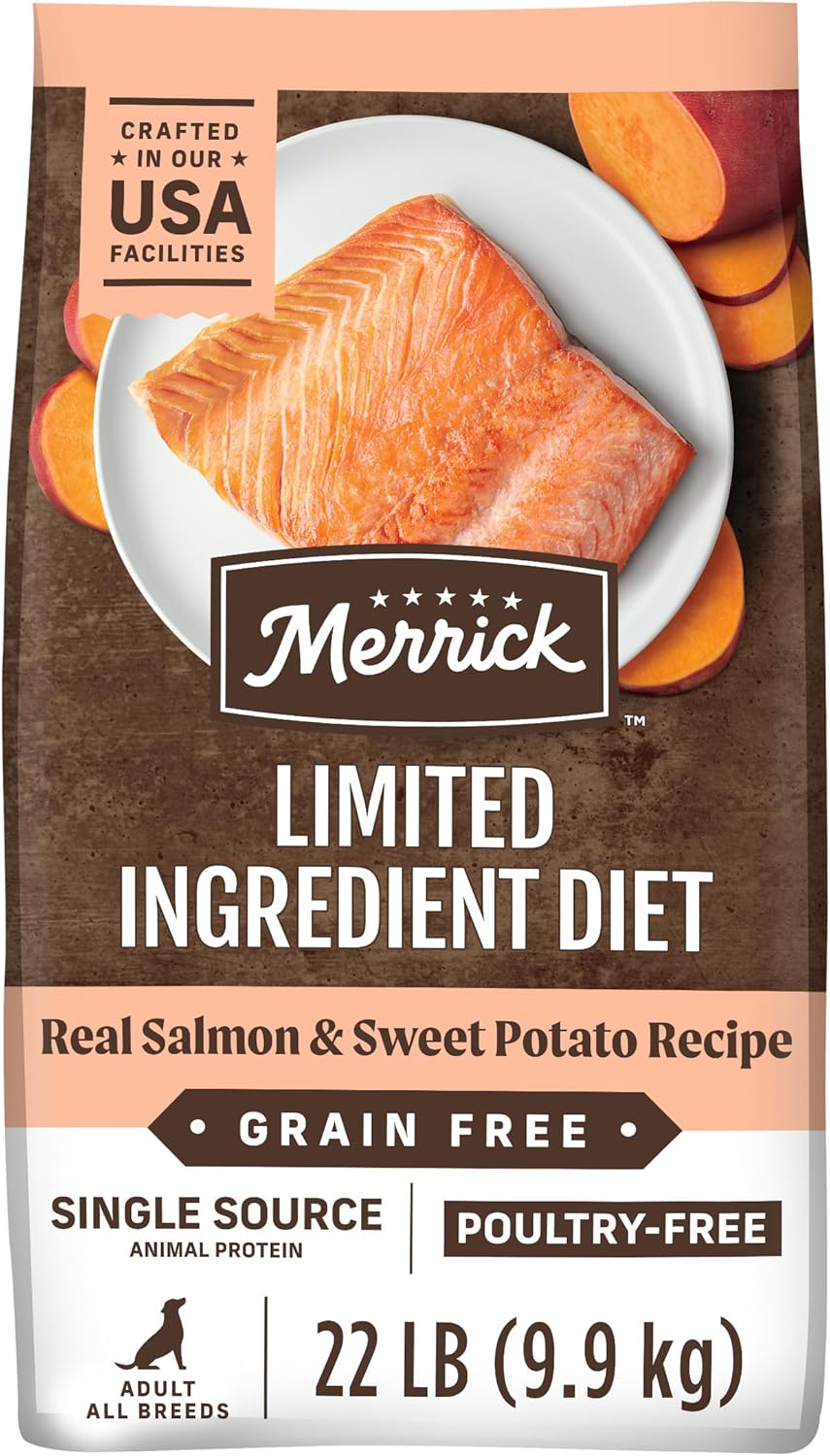
Merrick Limited Ingredient Diet Salmon
Merrick's Limited Ingredient Diet is grain-free and uses deboned salmon as the only animal protein source. Made in the USA with no artificial colors, flavors, or preservatives. A clean, transparent option for dogs with multiple food sensitivities who have not responded to chicken or turkey-based formulas. The short ingredient list makes it easy to rule out allergens systematically.
- Made in the USA
- Single animal protein: easy allergen tracking
- Grain-free formula
- No artificial ingredients
- Smaller bag sizes available
- Some dogs prefer poultry-based food
Quick Comparison Table
| Product | Grain-Free | Probiotics |
|---|---|---|
| Purina Pro Plan | ||
| Hill's Science Diet | ||
| Blue Buffalo Basics | ||
| Royal Canin | ||
| Merrick LID |
Our Final Recommendation
For most dogs with sensitive stomachs, Purina Pro Plan Sensitive Skin & Stomach offers the best combination of quality and proven results, with live probiotics built in.
If your dog has specific food allergies or has failed multiple formulas, go with Blue Buffalo Basics or Merrick LID for the cleanest limited-ingredient approach. If your vet has specifically recommended a food switch, Hill's Science Diet is the standard recommendation.
See Purina Pro Plan on AmazonBest Dog Food for Puppies with Sensitive Stomachs
Quick answer: Puppies with sensitive stomachs need a growth-formulated food with a single protein and moderate fat; transition slowly and feed small frequent meals.
Puppies with sensitive stomachs need a formula specifically designed for growth. Adult sensitive stomach formulas do not meet the higher protein, calcium, and DHA requirements of a developing puppy. Never feed a puppy an adult-only formula, even if it seems gentler.
When transitioning a puppy, go even slower than the standard plan. Watch for changes in stool consistency as your primary indicator of how the transition is going.
If your puppy is a large breed, make sure the puppy formula is specifically labeled for large breeds, since large breed puppies need a different balance of minerals for bone growth.
If Kibble Keeps Not Working
If you have already worked through a few limited-ingredient kibbles without real improvement, fresh food is worth a mention. JustFoodForDogs makes human-grade meals with a short, named-ingredient list and no rendered meals or fillers, which some owners find settles a sensitive stomach that kept reacting to kibble after kibble. It is not a cure and it is not cheap: it costs meaningfully more per month than any formula above, and you still need to introduce it slowly like any other food change.
Sensitive Stomachs by Breed
Quick answer: Breed-specific points are listed below.
Here are breed-specific points to raise with your vet.
German Shepherd
If digestive signs persist, ask your vet to check for conditions such as exocrine pancreatic insufficiency or inflammatory bowel disease.
Great Dane
Large, deep-chested dogs have a higher risk of bloat (GDV), and body size is one risk factor.[3] In a case-control study of large and giant breeds, a larger volume of food per meal was linked to higher risk.[4] Ask your vet about a feeding plan.
Boston Terrier
A slow feeder bowl is a practical step for a dog that gulps its food. Ask your vet if gas or regurgitation continues.
Chihuahua
Small breeds can suit small dogs better when they need smaller kibble. Ask your vet about a feeding plan that suits your dog.
Pitbull
Beef, dairy, chicken and wheat are the most likely food allergens in dogs, whatever the breed.[1] A limited-ingredient diet with a novel protein is one option to discuss with your vet.
Labrador
A dog that is eating too fast may have more digestive upset. A slow feeder bowl is a practical step to try. Ask your vet if vomiting continues.
How to Transition Your Dog to a New Food
Quick answer: Switch food gradually over several days, mixing increasing amounts of the new food, to avoid the loose stools a sudden change causes.
Never switch dog food abruptly: a sudden switch can upset a sensitive stomach. Follow this 7-day transition plan and extend it to 10–14 days if your dog is especially sensitive: (AKC)
- Days 1–2: 75% old food, 25% new food
- Days 3–4: 50% old food, 50% new food
- Days 5–6: 25% old food, 75% new food
- Day 7+: 100% new food
Some owners add a plain probiotic such as Purina FortiFlora during a transition. The evidence for probiotics is mixed; see the probiotics section below.
Wet Food vs Dry Food for Sensitive Stomachs
Quick answer: Wet food adds moisture and is often gentler on the stomach, but dry kibble is more convenient; both work if the protein is gentle.
Both wet and dry food can work well for sensitive-stomach dogs. Wet food has higher moisture content and is often more appealing to dogs that have lost interest in eating due to GI discomfort. However, high-quality dry kibble formulated for sensitive stomachs can work as well for many dogs.
If you want to try wet food, the same brand options apply: Purina Pro Plan and Hill's Science Diet both offer wet versions of their sensitive stomach formulas. You can also mix wet food with dry kibble as a halfway approach that improves palatability without the full cost of an all-wet diet.
Bland Food for an Upset Stomach: What Vets Say
Quick answer: Boiled chicken and rice is the traditional "bland diet", but veterinary sources do not agree on it. VCA Animal Hospitals calls it no longer the best recommendation, while the Merck Veterinary Manual still lists chicken and rice among the bland diets used for some conditions. Ask your vet what your dog should eat and for how long.
VCA Animal Hospitals says the term "bland diet" has lost favor among veterinarians because it is not specific, and that boiled chicken breast with white rice is no longer the best recommendation.[7] Its reasons: the mix is not complete and balanced (VCA describes it as lacking more than ten essential nutrients), its calories vary with the cut of chicken and the chicken-to-rice ratio, and it is hard to measure how much your dog is really eating.[7] VCA points to veterinary therapeutic gastrointestinal diets as the better option, and says that if your vet recommends a bland diet you should ask exactly what they mean.[7]
The owner guide in the Merck Veterinary Manual is less categorical. It mentions bland diets "often prescription food or chicken and rice" in the management of stomach ulcers, and "cottage cheese and rice or a prescription diet" when a dog is slowly restarting food after the vomiting of parvovirus has stopped, both in the context of veterinary treatment.[8]
The two sources also differ on fasting. VCA says vets once advised withholding food for 24 to 48 hours but that the gut is now understood to need nutrients while it recovers, with exceptions your vet may make, such as profuse vomiting.[7] Merck says short-term gastritis often responds well to fasting and avoiding whatever triggered it, and, for parvovirus, that providing nutrition earlier is associated with earlier improvement.[8] What both agree on is the practical point: follow your veterinarian's instructions for your dog's diet.[7][8]
For that reason we do not give a home recipe here. If your vet does recommend a home-prepared meal, ask for the exact ingredients, amounts and number of days, and follow the transition plan above afterwards. A bland meal does not fix the cause, so if stomach trouble keeps coming back, that is a reason to talk to your vet and look at the formulas in this guide.
When a Food Change Is Enough, and When It Is Not
Quick answer: If a food change does not resolve symptoms, or if you see blood, vomiting, or weight loss, see a vet.
Most dogs with sensitive stomachs improve with the right food alone. But not all digestive symptoms are food-related. Here is how to tell the difference between a food sensitivity you can solve at home and a medical condition that needs a vet.
There is a line the veterinary literature draws that is worth knowing, because it is more useful than any symptom list. The Merck Veterinary Manual defines a digestive problem as chronic once it has lasted, or kept coming back, for more than three weeks. Before that line you are managing an upset stomach. After it you are managing a condition, and the food is at best half the answer.
The same source is blunt about what does not wait for three weeks: vomiting more than once or twice a day, or with blood, belly pain, weakness, fever or weight loss, needs a proper examination rather than a new bag of food. Weight loss is the one owners most often explain away, and it is the one that should worry you most.
Symptoms That Usually Improve with a Food Change
These signs can point to a dietary trigger, and many improve within a few weeks on a suitable formula:
- Occasional vomiting that happens shortly after eating (not vomiting bile on an empty stomach)
- Soft or loose stools that firm up with probiotics or a food switch
- Excessive gas that follows specific meals or ingredients
- Mild bloating or stomach gurgling that is not accompanied by pain
- Itching or ear infections alongside digestive symptoms (suggests a food allergy)
- Symptoms that clearly worsen after introducing a new treat, table scrap, or food brand
In these cases, switching to one of the five foods reviewed above and following the gradual transition plan may be enough. Track symptoms in a simple notebook or phone note during the transition: objective data makes it much easier to tell if things are improving week over week.
Symptoms That Need a Vet, Not Just a Food Change
These red-flag signs suggest an underlying medical condition that food alone will not fix. A vet visit is the right next step, not another food experiment:
- Blood in vomit or stool (fresh red blood or dark, tarry stool)
- Repeated vomiting over more than a day or two
- Significant weight loss over weeks or months despite a normal appetite
- Lethargy, depression, or obvious pain alongside digestive symptoms
- Diarrhea that does not respond to a fair food trial
- Vomiting bile (yellow foam) on an empty stomach, especially in the morning
- Symptoms that began suddenly after a known toxin exposure (chocolate, xylitol, grapes, human medication)
Key decision rule: If your dog is still bright, active, eating with appetite, and having soft-but-not-watery stool, a food change is the right first step. If your dog is clearly unwell, not just having digestive symptoms but actually sick, skip the food trial and go straight to the vet. You can always switch foods afterward, once you know what you are dealing with.
Feeding Habits That Reduce Sensitive Stomach Symptoms
Quick answer: Slow feeders, scheduled meals and avoiding table scraps are practical steps to try.
Sometimes the problem is not the food itself: it is how the dog eats it. Before you switch foods, try these habit changes that cost nothing and help many dogs within days:
- Split meals: Smaller meals can suit some dogs. In a case-control study of large and giant breeds, a larger volume of food per meal was linked to higher bloat risk.[4]
- Use a slow feeder bowl: A slow feeder can help a dog that eats very fast. It is a practical step to try, though it may not solve every case.
- No exercise right after meals: Rest your dog after eating before walks or active play, and ask your vet about the right timing.
- Consistent schedule: Feed at roughly the same times every day.
- Eliminate table scraps: Human food, especially fatty meat, dairy or processed snacks, can make some dogs flare up. Keep treats consistent while you trial a food.
What the Research on Probiotics Actually Shows
Probiotics are often recommended for sensitive stomachs, so it is worth being precise about the evidence. A 2024 systematic review and meta-analysis of randomised trials in dogs with acute diarrhoea found that nutraceuticals (prebiotics, probiotics and synbiotics) did not show a clinically significant effect on how long diarrhoea lasted, although the certainty of that evidence was low to moderate.[2] Evidence: limited No adverse effects were reported in the studies it reviewed.
In a randomised, double-blinded, placebo-controlled trial of 60 dogs with acute diarrhoea, a probiotic combination, oral metronidazole and placebo were compared.[5] Dogs on the probiotic reached acceptable faecal consistency fastest on average (3.5 days, against 4.6 days with metronidazole and 4.8 days with placebo), but the difference was not statistically significant (p = 0.17). The authors concluded that the results did not support the common use of metronidazole in this group, and that a larger study would be needed to detect a probiotic effect. Evidence: limited
One placebo-controlled trial of 148 client-owned dogs with acute diarrhoea reported a shorter course with a probiotic paste: a median of 32 hours against 47 hours on placebo.[6] Evidence: limited Two of its three authors were affiliated with ADM Protexin Ltd. The evidence is mixed, so a plain probiotic is low risk to try, but it is not a proven fix. Ask your vet before adding one.
Frequently Asked Questions
Also worth reading: Best Automatic Pet Feeders: feeding your dog on a consistent schedule with portioned meals can help reduce sensitive stomach symptoms. And if you have a cat in the house too, check out our Best Cat Litter guide.
Willemijn has kept animals for around 45 years. She did not have these particular items in her own home. What follows is her read on them, put together from research and from what she has seen at other owners' houses. We keep it separate from her hands-on notes on purpose, because the two are not the same thing.
Purina Pro Plan Sensitive Skin & Stomach Salmon & Rice. His coat got a little glossier and the itching eased off a bit. Stool was good. Drawback: Dearer than the standard version.
Purina Pro Plan Large Breed Sensitive Skin & Stomach.
Blue Buffalo Basics Limited Ingredient Turkey & Potato. The diarrhoea eased, but it did not clear up completely. Drawback: It did not fully solve the problem.
Hill's Science Diet Sensitive Stomach & Skin Chicken. His stool got somewhat better, but he did not enjoy eating it. Drawback: The taste disappointed.
Willemijn is a friend of the founder and is not paid for this.
References
- Mueller RS, Olivry T, Prélaud P. Critically appraised topic on adverse food reactions of companion animals (2): common food allergen sources in dogs and cats. BMC Vet Res, 2016. PubMed
- Scahill K, Jessen LR, Prior C, et al. Efficacy of antimicrobial and nutraceutical treatment for canine acute diarrhoea: A systematic review and meta-analysis for European Network for Optimization of Antimicrobial Therapy (ENOVAT) guidelines. Vet J, 2024. PubMed
- McCord MA, O'Brien J, Ryave J, et al. Gastric dilatation-volvulus is associated with Poodle breeds, increased body size, and male sex, but not primary diet type or anxiety in the Dog Aging Project cohort. J Am Vet Med Assoc, 2026. PubMed
- Raghavan M, Glickman N, McCabe G, et al. Diet-related risk factors for gastric dilatation-volvulus in dogs of high-risk breeds. J Am Anim Hosp Assoc, 2004. PubMed
- Shmalberg J, Montalbano C, Morelli G, Buckley GJ. A Randomized Double Blinded Placebo-Controlled Clinical Trial of a Probiotic or Metronidazole for Acute Canine Diarrhea. Front Vet Sci, 2019. PubMed
- Nixon SL, Rose L, Muller AT. Efficacy of an orally administered anti-diarrheal probiotic paste (Pro-Kolin Advanced) in dogs with acute diarrhea: A randomized, placebo-controlled, double-blinded clinical study. J Vet Intern Med, 2019. PubMed
- VCA Animal Hospitals (Canadian Academy of Veterinary Nutrition; reviewed by Caitlin Grant, DVM, and Lynn Buzhardt, DVM). Bland Diet Instructions: Nutrition for Dogs and Cats with Gastrointestinal Upset. Last updated July 12, 2024; read November 5, 2026. VCA Animal Hospitals
- Merck Veterinary Manual, Pet Owner Version. Disorders of the Stomach and Intestines in Dogs. Last updated June 2026; read November 5, 2026. Merck Veterinary Manual